Or if a Path Was Included
Modifying Your Path
- The PATH demystified
- Adding a directory to our PATH
- Temporarily
- Permanently
- I last important note
Unix
When I was starting out, the whole concept of what the "PATH" was and what it did was way more than confusing to me than it needed to be. For some reason I simply didn't come up across a straightforwrard explanation for a long time (or wasn't paying attention or understanding if I had…). Either way, after I got it, I was like "Why didn't anyone just tell me this??", haha. If the "PATH" is still a nebulous concept for you, then you've come up to the right place 🙂
The PATH demystified
As mentioned in the intro to Unix section, i of the easiest mistakes to brand at the command line is to be trying to specify a file or plan that isn't where we recollect it is. For files, we usually betoken to where the file is (if it's non in our electric current working directory) using the accented or relative path, where "path" hither, in lowercase, merely means a sort of address in the computer. Only for programs that we utilise ofttimes, we commonly want to be able to telephone call them without having to provide the complete path to wherever the program is located. So a big part of getting specific programs to work properly at the control line is having them in a location on the figurer that we can admission no matter where we are.
The command line automatically checks in a list of pre-defined locations (directories) everytime we are trying to call a sure command. This is why we tin can use sure commands like ls and pwd and such from any directory we happen to be in. This list of pre-designated directories is stored in a special variable called the "PATH" (all caps required). We can see our PATH, and which directories are stored in it, by entering repeat $PATH at the command line (the $ is used to call variables in bash and other Unix languages; see the variables if new to this). Here's a await at mine:
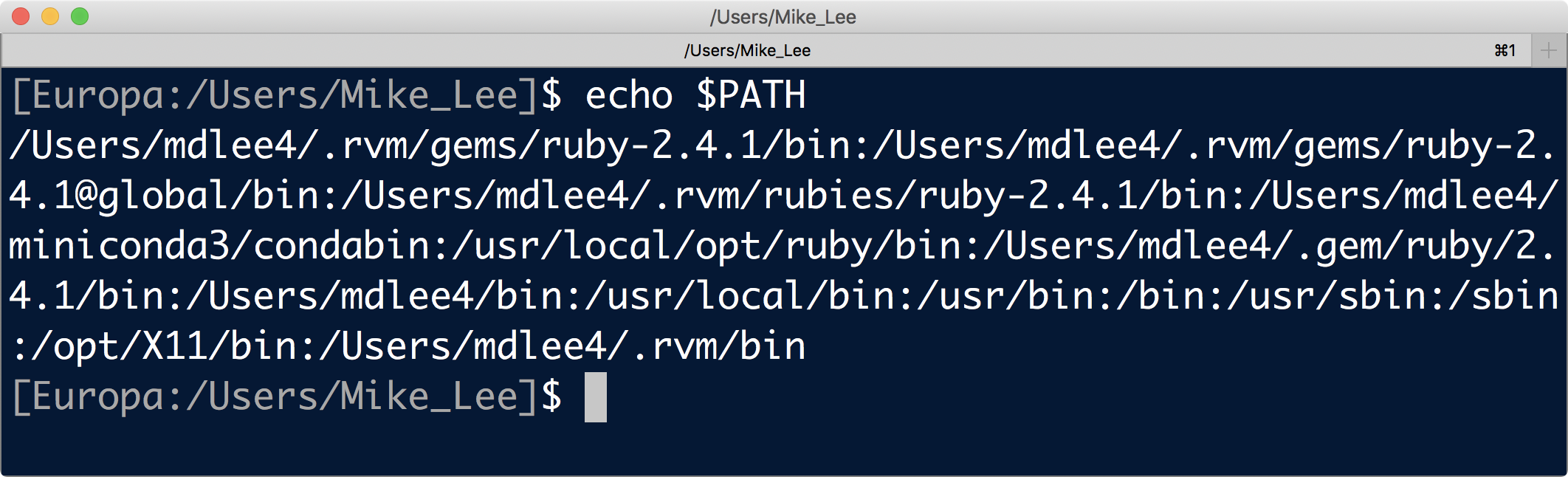
This is a colon-delimited list of all the directories the command line looks in past default for programs. To make it a picayune friendlier to glance at, nosotros can change the colons to newline characters by piping the output of echo $PATH into tr , one of our half-dozen glorious commands, to change the colons to newline characters for a more user-friendly output:
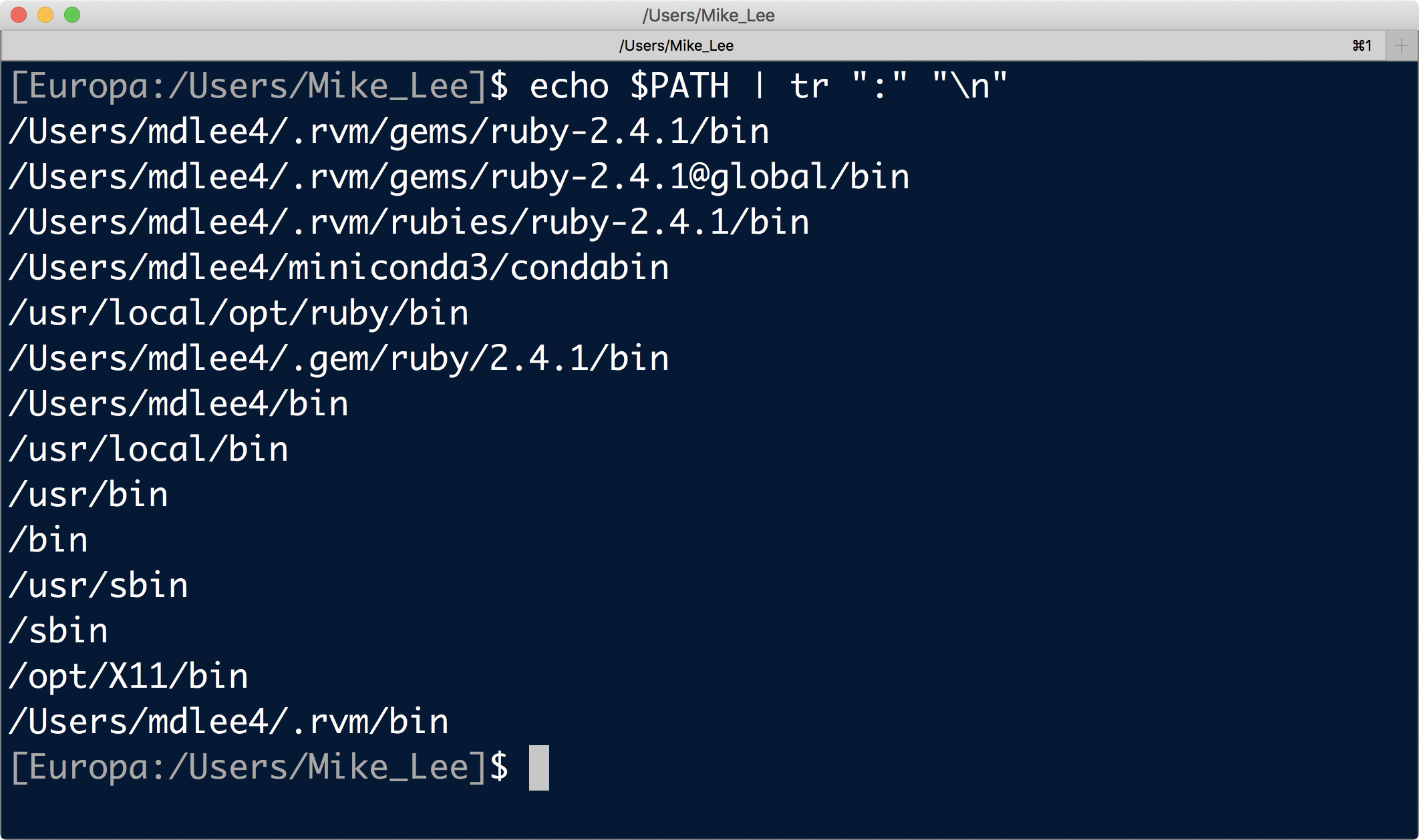
We tin can now more than conspicuously see this is a list of directories. All of these places, stored in the variable chosen "PATH", are searched whenever we are typing a command in the terminal window. If the command we are trying to use is present in any of the directories listed in our PATH, we don't need to betoken at its specific location in full (its path, lowercase) when we are trying to use it – which is of course nice for things we use often.
To make a program bachelor anywhere, nosotros can either place that program in a directory that's already in our PATH, or we can add a new directory to our PATH that contains the program. (Keep in mind that the social club in which things appear in our PATH does matter. If we have ii versions of a programme with the same name, whichever shows upwardly first will exist the one that's used.)
Adding a directory to our PATH
To demonstrate how to add a directory to our PATH, we're going to create a new directory and inside information technology make a quick bash script that tells us what time information technology is. We're then going to add that directory to our PATH so that we tin utilise the time-telling script from anywhere. If you want to follow along, y'all can brand both by copying and pasting the post-obit code block. If the post-obit is confusing to you at showtime glance, running through the Unix crash course will become you lot about entirely upward to speed. For now, this is most the PATH though, then don't worry besides much about whatsoever small-scale details of this script – though a quick explanation follows 🙂
mkdir my-bin cd my-bin true cat >> what-fourth dimension-is-it.sh << ' EOF ' #!/bin/bash current_time= $( date | tr -s " " " \t " | cut -f 4 | cut -d ":" -f 1,2) echo "The time is $current_time . I'm glad to see you're making practiced utilise of it :)" EOF chmod +x what-time-is-it.sh ls cat what-fourth dimension-is-it.sh 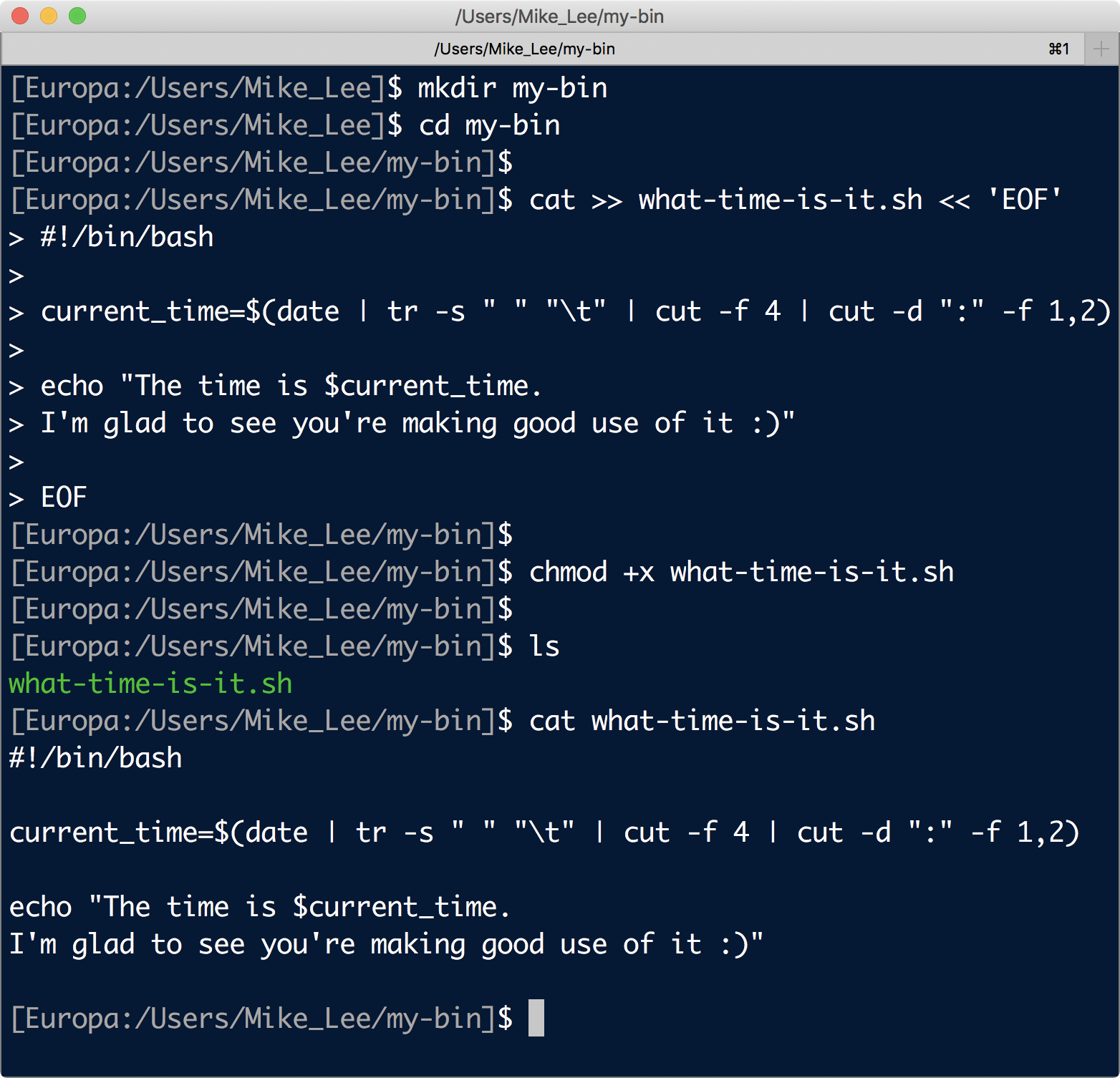
Ok great, so we merely wrote a plan that tells us what time it is according to our estimator. That cat >> what-time-is-it.sh << 'EOF' line is say to put whatever we type that follows into that file we are only creating, up until we type "EOF". Then for the little example script: #!/bin/bash tells the computer which program to utilise when executing the script; the current_time line is us setting a variable, called "current_time", and storing inside it the fourth dimension that we utilise some unix magic to cut out of what the command date outputs; and then we are having information technology echo out the sentences (impress to the terminal) and inserting the variable $current_time . Annotation the $ hither is simply calling the variable in the same style as when we did repeat $PATH above. The final little part chmod +x what_time_is_it.sh is irresolute the properties of the file so that the computer knows information technology's a program and will let us execute information technology more conveniently.
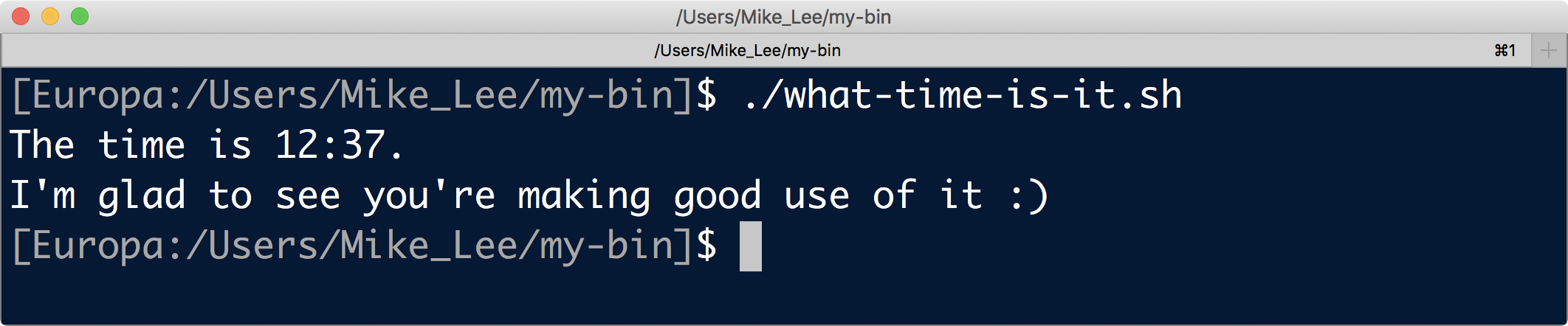
Allow's requite it shot now. At the moment, the "what-fourth dimension-is-it.sh" script is not in our PATH. It exists only in the directory nosotros are sitting in, and that directory is non in the list of directories that pops up when we run repeat $PATH . So correct at present, to execute the plan, we need to tell the computer where it is with its relative or absolute path. Executing a file is unlike than doing something to it like nosotros did with the cat command). And to execute a program, we demand to be a bit more than explicit fifty-fifty if it'southward sitting in our electric current working directory. Here we'll use the relative path, which looks similar this:
And note, if we are not in this working directory that contains the script, we accept to point to it in much the same way. Here, let's move up one level and endeavor once again:
cd .. ./what-fourth dimension-is-information technology.sh my-bin/what-time-is-it.sh 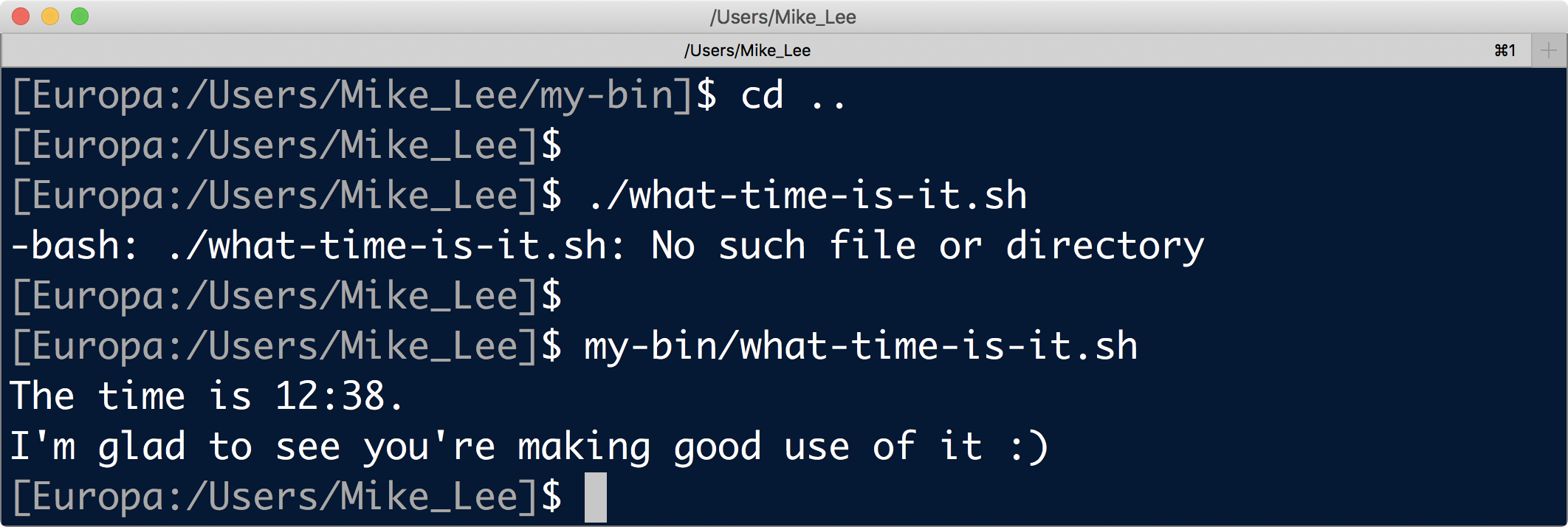
Now to brand our program accessible to u.s.a. wherever we are, without having to bespeak at its location (its path, lowercase), nosotros're going to add its directory, my-bin , to the list of pre-specified directories in our PATH (the variable, all caps). To remove as much of our mortal enemy as possible from the procedure (human being error), it'due south easiest to just modify into the directory nosotros want to add, run pwd, and copy the absolute path:
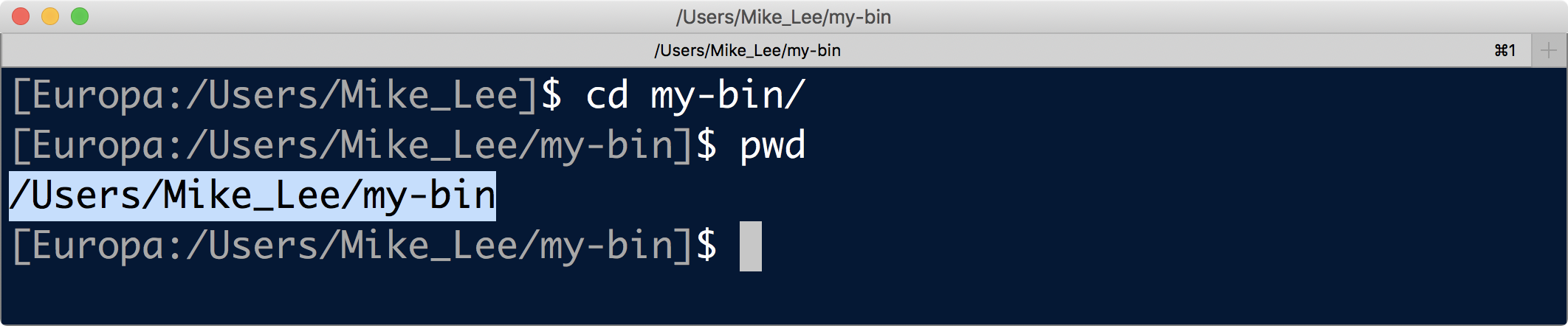
Now that the absolute path of the directory is patiently waiting in the purgatory betwixt copy and paste, we can modify our PATH to include it. This tin be washed temporarily or permanently, so let'southward run through both here.
Temporarily
Running the following code modifies the PATH just for the current terminal session, then when we close the window it volition exist gone. Here is what mine looks like, we'll break it down after looking at information technology:
export PATH = " $PATH :/Users/Mike_Lee/my-bin" 
Here, export is the control we are using, then we are specifying the variable we desire to fix, "PATH". So nosotros are saying we want to set the "PATH" variable to include everything that is already in the PATH, by first putting $PATH , and then we put a colon, which we saw in a higher place is what delimits the list of directories in the PATH variable, and so we added our new directory, /Users/Mike_Lee/my-bin in my case – that's the function you would modify to lucifer yours. (The export part of this is a little more into the weeds than we need here, merely basically it sets the variable for whatever sub-processes launched past the final.) Now if we look at my PATH like we did in a higher place, we see that at the finish the directory /Users/Mike_Lee/my-bin is included!
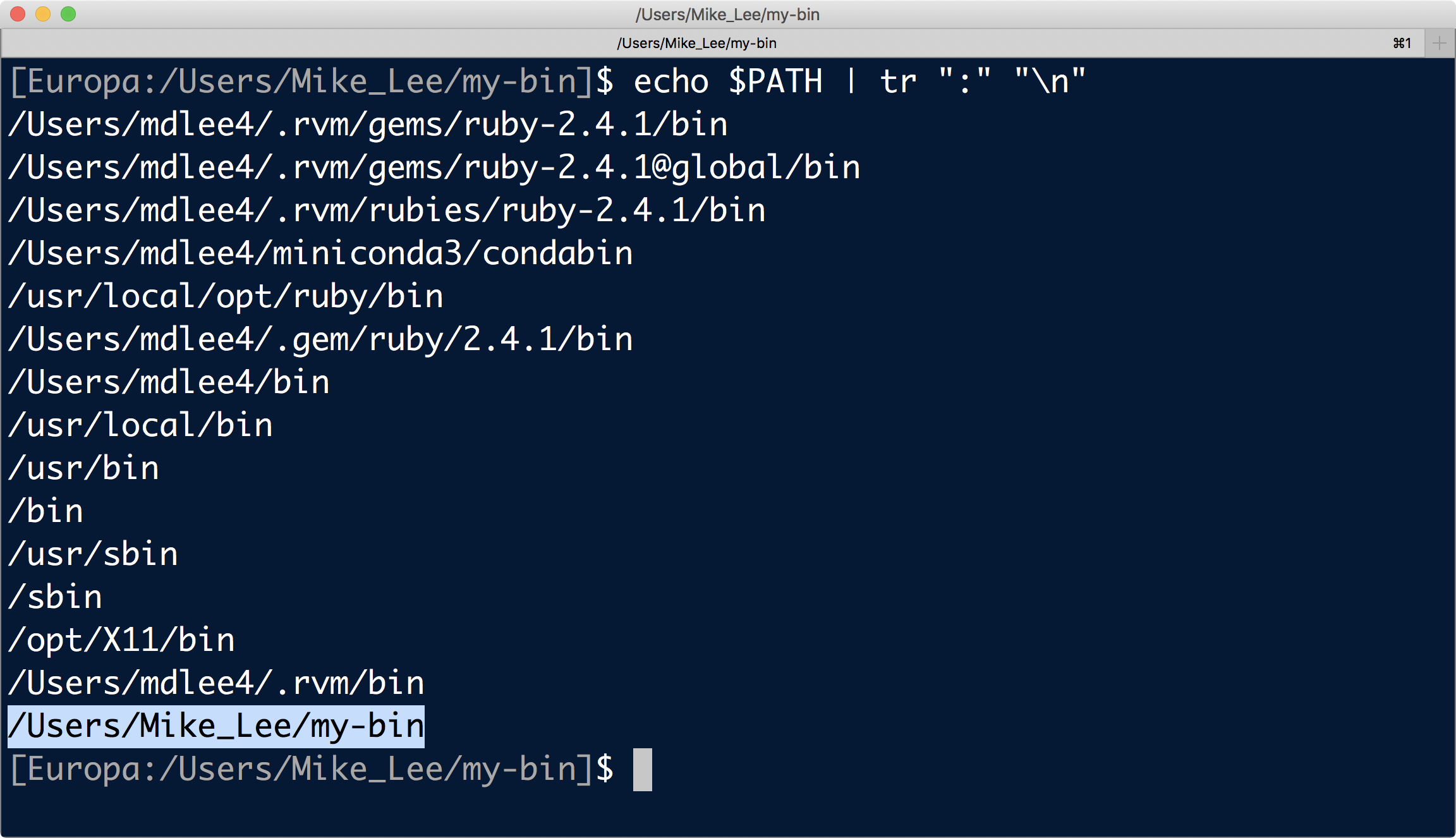
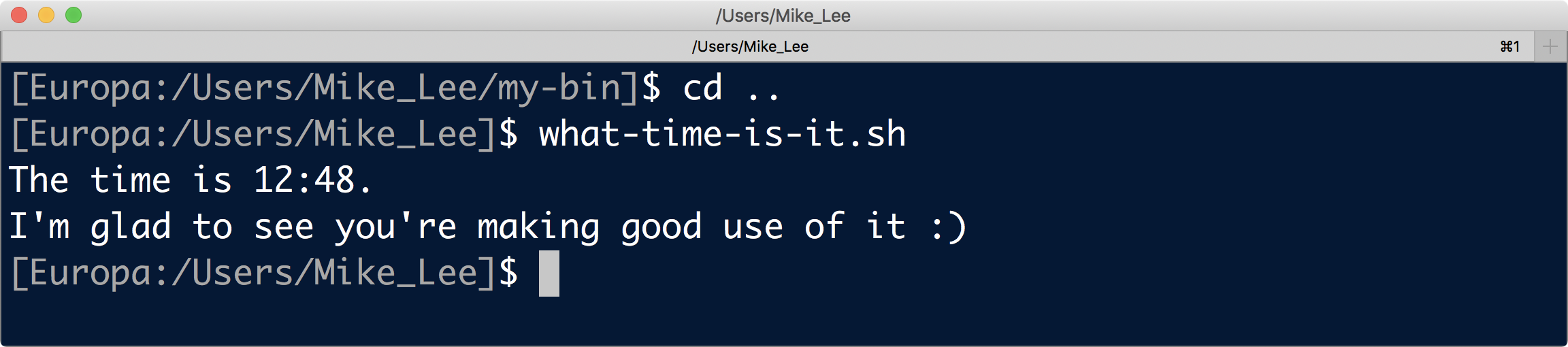
Beautiful, and to run into the benefits, nosotros tin can now run our what_time_is_it.sh plan without pointing to its location. Hither is in the directory it sits (without needing to have the ./ like we needed to a higher place):

But we can also exist anywhere else now:
Permanently
As noted above, that method but temporarily modifies our PATH, which is sometimes useful. Merely often nosotros volition want to alter information technology permanently. To do so we need to edit a sort of special file, there are a few of these, but that is a concept for another folio. The ane we are going to use hither is called ~/.bash_profile (files with a . in front of them are "subconscious" files). This file either already exists in our domicile directory or we will create it if it doesn't yet, and it gets run everytime we open a terminal window. This file and the others similar it are what let us to customize our terminal window with things like setting variables nosotros ever desire, adding color schemes, or modifying our prompt. Here is one way we can permanently add a directory to our PATH past using echo to append the code to the finish of that file:
NOTE
If we are working on a server or cluster, it may be the instance that we really want to modify our PATH varible in the~/.profilefile instead of the~/.bash_profilefile equally done below. If you lot bank check your domicile location withls -a ~/and you take a~/.contourbut no~/.bash_profile, then alter the two case lines below so that~/.profileis used in place of~/.bash_profile.
echo 'export PATH="$PATH:/Users/Mike_Lee/my-bin"' >> ~/.bash_profile Notation that the code is exactly the aforementioned equally we ran higher up, but at present we're appending information technology to the ~/.bash_profile . And since this file gets run each fourth dimension we open a terminal window, information technology's the aforementioned matter as if we did information technology ourselves everytime we opened a last window – except much better of course because we don't accept to really do it ourselves. Keep in mind that doing information technology this way, where we echo the text needed into the file, isn't the only way to do this. The ~/.bash_profile is just a text file, so we could open it with a regular text editor or a terminal-based one similar nano and enter the aforementioned text that fashion. Too, since this file is run everytime we open up a terminal session, it actually hasn't been run all the same since we merely updated it right now, then our PATH variable hasn't however been updated to include the directory we simply added. So we can either open a new terminal session, or we tin can run the source command on the ~/.bash_profile file like this:
And that's information technology! The PATH variable is only a special variable that contains all of the directories that are automatically searched when we effort to call a plan. Feel free to delete the what_time_is_it.sh script, but consider keeping the my-bin directory as a place to put things if you want them to be available from anywhere. Now that this directory is already in your PATH, you won't have to worry near that part anymore and anything y'all put in at that place volition be accessible from anywhere on that computer.
One last important note
We can add whatsoever directories to our PATH that we'd like, but we must exist sure to always include the $PATH variable like that in the list as we edit it, otherwise we might get stuck with no regular commands working anymore (like ls , pwd , wc , etc.). If that happens, don't despair! We can open up that ~/.bash_profile in any regular text editor (we may have to select "prove hidden files" or something like that in the Finder window in order to see it), and and then just delete whatever was added that messed things up. Then nosotros'll exist able to launch a new concluding once again that works just fine and endeavor again!
Source: https://astrobiomike.github.io/unix/modifying_your_path
0 Response to "Or if a Path Was Included"
Post a Comment